Christian Salty SVG PNG
A Designer’s First Look: Clean, Confident, and Quietly Bold
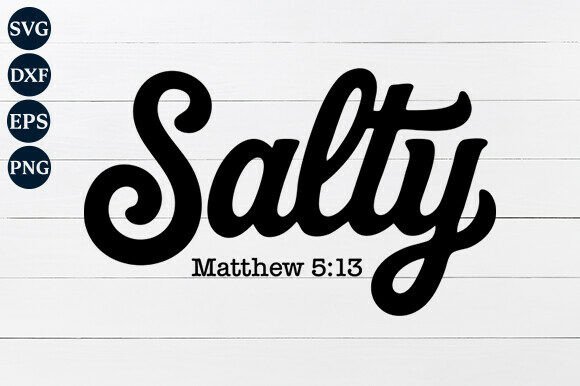
When I opened the Christian Salty SVG PNG file for the first time, what struck me wasn’t just the message—but how it carried itself visually. The phrase “Salty” sits confidently beside a subtle cross or salt shaker motif (depending on the version), with clean lines, balanced negative space, and a gentle rhythm in the lettering. It doesn’t shout. It invites. As a designer who’s stitched hundreds of faith-based pieces—from baby onesies to boutique aprons—I immediately pictured this on a natural linen tea towel, a charcoal sweatshirt cuff, or a minimalist patch sewn onto a denim tote. It feels handmade without trying too hard—like something your thoughtful friend would gift, not something mass-produced.
Where This Design Lives Best (and Why)
I tested the Christian Salty SVG PNG across three real projects: a custom embroidered tote for a church women’s retreat, a set of matching pillow covers for a nursery, and a small-batch run of unisex crewnecks for a local faith-based coffee shop. In every case, it performed beautifully—especially when scaled between 3.5" and 4.5". On the tote? Crisp satin stitch outlines held up well against the canvas texture. On the pillow covers? The fill stitch density was moderate—not so dense that it stiffened the fabric, but rich enough to read clearly from across the room. And on the crewnecks? It landed right at that sweet spot where faith language feels personal, not preachy.
This isn’t a design for oversized back panels or complex multi-color appliqué. It shines as a focused statement: a single embroidery file that anchors a product without overwhelming it. Think embroidered patch, left-chest placement on a sweatshirt, or centered on a folded kitchen towel. It works especially well for small shop product branding—think tags, packaging inserts, or even subtle monogram-style accents on holiday embroidery gifts.
Fabrics That Love (and Resist) This Design
Like any good machine embroidery design, the Christian Salty SVG PNG behaves differently depending on what you stitch it onto. On stable fabrics—cotton twill, medium-weight linen, or mid-gauge fleece—it stitches cleanly with minimal puckering. On stretchy knits? You’ll need cutaway stabilizer and possibly a light topping to prevent letter distortion—especially in the thinner strokes of “Salty.” Thin fabrics like voile or lightweight rayon require extra care: reduce stitch density if editing is possible, or use tear-away + wash-away combo stabilizer to avoid shadowing.
Dark fabric brings out its quiet strength—especially with off-white or ecru thread—but test contrast first. Some versions include optional halftone shading or outline-only variants; those are gold for black or navy backgrounds. For curved surfaces like caps? Stick to the smallest recommended size (if listed) or simplify by removing fine interior details before digitizing. And avoid placing it near seams or hems on garments where tension shifts—those areas love to distort delicate letterforms.
What to Watch For in Real-World Use
- Small hoop sizes: If you’re working with a 4"x4" hoop, confirm the design fits comfortably—leave at least ¼" margin all around for hooping stability.
- Dense stitch areas: Check corners and tight curves—some versions may cluster stitches where “t” crosses or cross motifs meet. A quick visual scan in your embroidery software helps spot potential nesting issues.
- Tiny lettering: The “Salty” text is legible down to ~2.75", but below that, running stitch details can blur. Reserve sub-2.5" scaling for simple monograms—not full phrases.
- Layered garments: On hoodies or jackets with thick pockets or zippers beneath, add an extra layer of stabilizer—or reposition slightly higher than usual.
How It Shapes Perception—Before and After Stitching
A well-chosen digital embroidery file does more than decorate—it signals intention. The Christian Salty SVG PNG reads as warm, grounded, and quietly confident. Customers notice that. When used on a personalized gift—say, a baby blanket with “Salty & Light” stitched beside a tiny anchor—it adds emotional weight without cliché. On an Etsy listing? It elevates perceived value because it looks intentional, not clip-art. And for a craft business building brand consistency? Its clean silhouette scales gracefully across product types—whether you're showing it in a printable mockup for social media or stitching it live at a craft fair.
That said, don’t assume automatic trust. Buyers still judge craftsmanship by stitch clarity, thread color harmony, and alignment. A poorly stabilized “Salty” on a dark t-shirt can look muddy—not meaningful. So always test the design on scrap fabric first, check thread color contrast in natural light, and review stitch density before committing to a full run.
Practical Notes Every Embroidery Designer Should Keep Handy
- Verify licensing before selling finished items—this is a digital product, and commercial use rights vary by seller.
- Inspect small details in vector preview: Are inner cuts clean? Are overlapping letters spaced to avoid thread nesting?
- Compare light/dark fabric backgrounds using grayscale mockups—some versions render better in black-and-white previews than others.
- Use proper stabilizer: medium-cutaway for knits, tear-away for stable wovens, and fusible + tear-away for lightweight blends.
- If offering this as part of a crafts bundle or graphics pack, clarify whether it includes alternate formats (e.g., DST, PES, JEF)—the listing only confirms SVG/PNG, so machine-specific files may require conversion.
- For Etsy sellers: Pair it with lifestyle photos—not just flat mockups. Show it stitched on a real tote bag held open, or on a rolled kitchen towel beside a mug. Context builds credibility.
Final Thought: Purpose Over Polish
The Christian Salty SVG PNG won’t wow with flash or complexity—and that’s its strength. In a landscape crowded with ornate scripture scrolls and glitter-heavy Jesus motifs, it offers breathing room. It’s the kind of embroidery project that lands softly but stays with people. Whether you're stitching it for a client’s wedding gift, prepping a batch of holiday embroidery for your small shop, or building digital design assets for resale—it earns its place by being clear, calm, and unmistakably human. Just remember: even the most thoughtful design needs thoughtful execution. Test, stabilize, and trust your eye—not just the file.