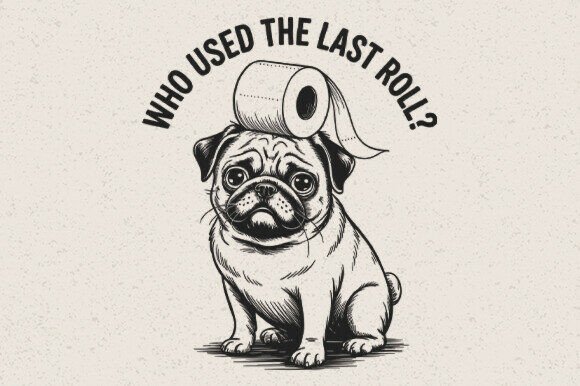
Who Used the Last Roll Dog SVG: Crafts & Graphics for Local Branding
As a brand designer who’s developed visual identities for over 40 local businesses—from artisanal candle studios in Asheville to family-run bakeries in Portland—I opened Who Used the Last Roll Dog SVG expecting playful irreverence. What I found was a tightly crafted, scalable graphic design asset with surprising versatility for small business branding. It’s not just clipart—it’s a mood, a tone, and a subtle storytelling device that works best when anchored in authenticity.
The illustration features a cartoonish but expressive dog mid-“crime scene” investigation beside an empty toilet paper roll—tongue out, paw raised, eyes wide with comedic accusation. The linework is clean and confident; the composition leaves generous breathing room around the central figure. It reads as friendly, lightly mischievous, and unmistakably handmade—not polished corporate, but thoughtfully designed. That makes it ideal for brands leaning into warmth, approachability, and human-centered charm: think small-batch skincare labels, coffee shop merch, boutique soap packaging, or seasonal greeting cards from a floral studio.
In real-world use, Who Used the Last Roll Dog SVG shines where personality meets practicality. For a handmade soap business launching a “Bathroom Bliss” limited-edition line, this graphic became the hero element on front-label die-cuts, hang tags, and Instagram story banners. Paired with a warm serif font and soft sage green, it elevated shelf appeal without sacrificing clarity. On product mockups, it added instant narrative—customers didn’t just see soap; they saw a moment of shared humor in daily ritual. That emotional connection translates directly to recall, trust, and repeat purchase.
This graphic design asset supports stronger local business presentation in several measurable ways:
- Better product recognition — Its distinct character stands out amid generic stock illustrations on crowded retail shelves or Etsy listings.
- Clearer visual hierarchy — When scaled as a focal accent (not background filler), it guides the eye naturally to key messaging like flavor names or scent notes.
- More consistent brand identity — Because it’s delivered in SVG, EPS, and PDF formats, it scales flawlessly across packaging, social media graphics, and printed thank-you cards—no pixelation, no distortion.
- Improved customer trust — Hand-drawn energy signals care and craft, reinforcing the authenticity local shoppers actively seek.
- Stronger emotional connection — Humor rooted in real life (“bathroom moments”) builds rapport faster than abstract icons or overused botanical motifs.
Where does Who Used the Last Roll Dog SVG work best? Think context-first: product labels where wit complements function (e.g., “Toilet Paper Rescue Kit” gift boxes), packaging accents that break up minimalism without clutter, hero graphics for email headers or website banners, decorative brand elements on reusable shopping bags, seasonal campaign visuals (think “Holiday Roll Call” for a pet-friendly bakery), and social media graphics that stop scrollers mid-feed.
Use it carefully in formal corporate branding, ultra-minimalist luxury packaging, or anywhere critical text competes for attention. Avoid placing it on ingredient-heavy food labels where regulatory info must dominate—or on low-contrast backgrounds where the PNG transparency might blur edges. It’s also not ideal for tiny applications like ½-inch sticker dots or QR code overlays, where detail loss undermines its charm.
Before deploying Who Used the Last Roll Dog SVG in client work or physical product sales, here’s what I always test:
- Real packaging mockups — Does it hold impact at 2” x 2” on a candle jar label? Does it read clearly on kraft paper versus glossy white?
- Black-and-white usage — Many small businesses print in grayscale first—does the line weight stay legible?
- Brand color compatibility — Try it against your palette’s lightest and darkest tones. Does it pop—or disappear?
- Font pairings — Test beside serif (for tradition), sans serif (for modern clarity), script (for handmade warmth), and display fonts (for event-driven campaigns).
- SVG editability — Open the vector file in Illustrator or Affinity Designer. Can you isolate the dog, adjust stroke weight, or recolor individual elements without breaking paths?
- PNG transparency — Drop it onto textured backgrounds (linen, concrete, wood grain). Does the edge remain crisp?
- Commercial licensing — Confirm the license explicitly permits use on physical products, resale items, and promotional materials—non-negotiable for professional branding.
For creative entrepreneurs sourcing design assets from the broader creative marketplace, Who Used the Last Roll Dog SVG represents a smart middle ground: more intentional than generic clipart, more adaptable than rigid Canva templates, and far more brand-aligned than off-the-shelf illustration packs. It’s not a logo design—but it can become a memorable pillar of your packaging design system. Not a full brand identity—but it adds tonal consistency across touchpoints, from printable inserts to social media graphics.
Ultimately, Who Used the Last Roll Dog SVG succeeds because it understands local business reality: customers don’t buy products—they buy moments, moods, and meaning. When paired with thoughtful typography, intentional color, and genuine brand voice, this single graphic design asset becomes more than decoration. It becomes part of the story your small business tells—and that’s where real brand equity begins.